Find out how small hospitals can choose hospital management software that fits their workflows and budget. Explore essential modules, cloud and on-premise deployment, pricing considerations, staff training and questions to ask before choosing a vendor.
A small hospital runs the same operations as a large one: registration, doctor schedules, billing, a pharmacy, a lab. The difference is that fewer people hold it all together. When the billing clerk also manages the front desk, a missed entry or a misplaced file has nowhere to hide.
Hospital management software exists to take that load off your team. The harder question is which software fits a small hospital rather than a large campus. This guide covers what to prioritise, what to ask in a demo, and how to avoid paying for modules you will not use.
What hospital management software does in a small hospital
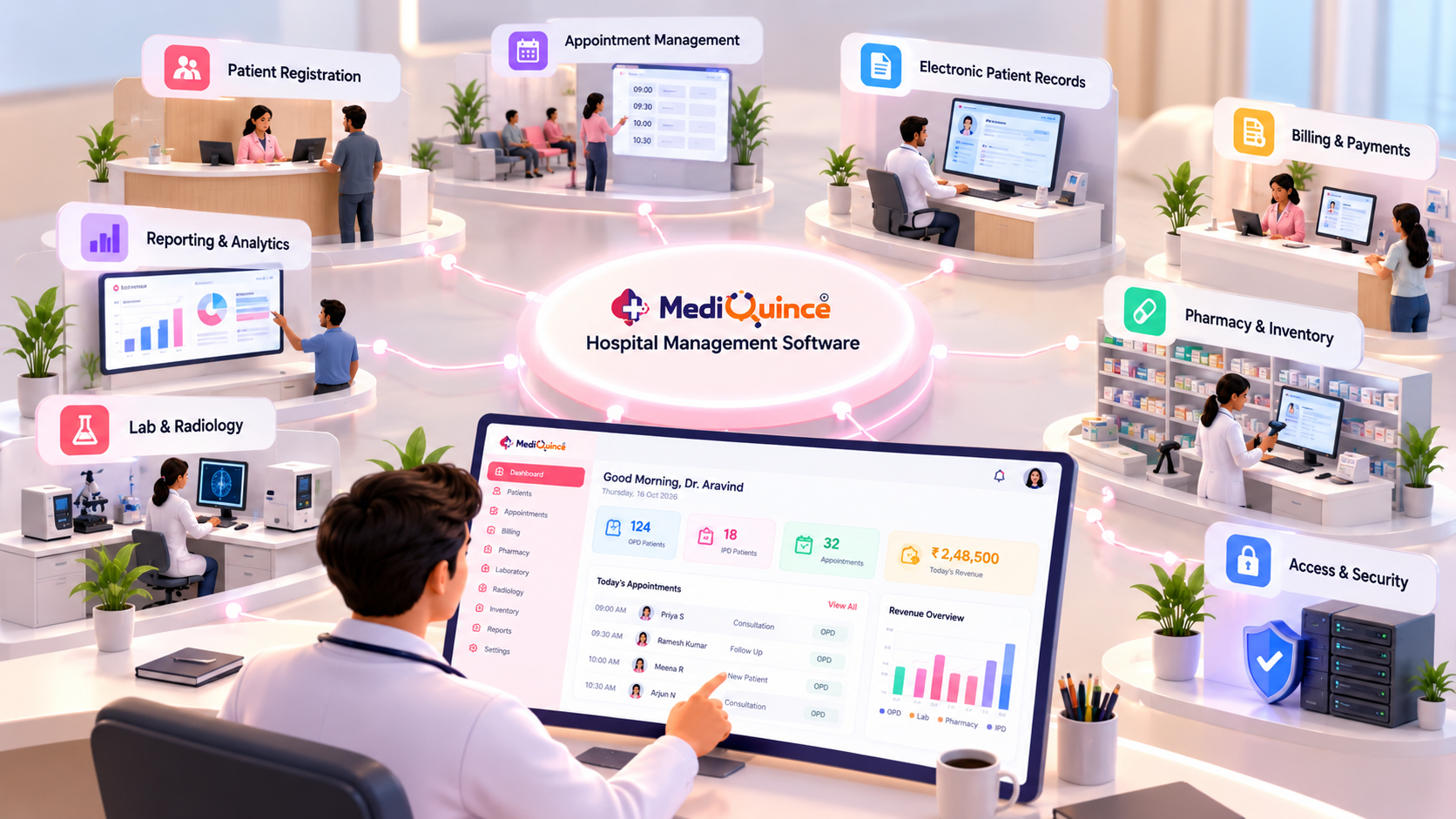
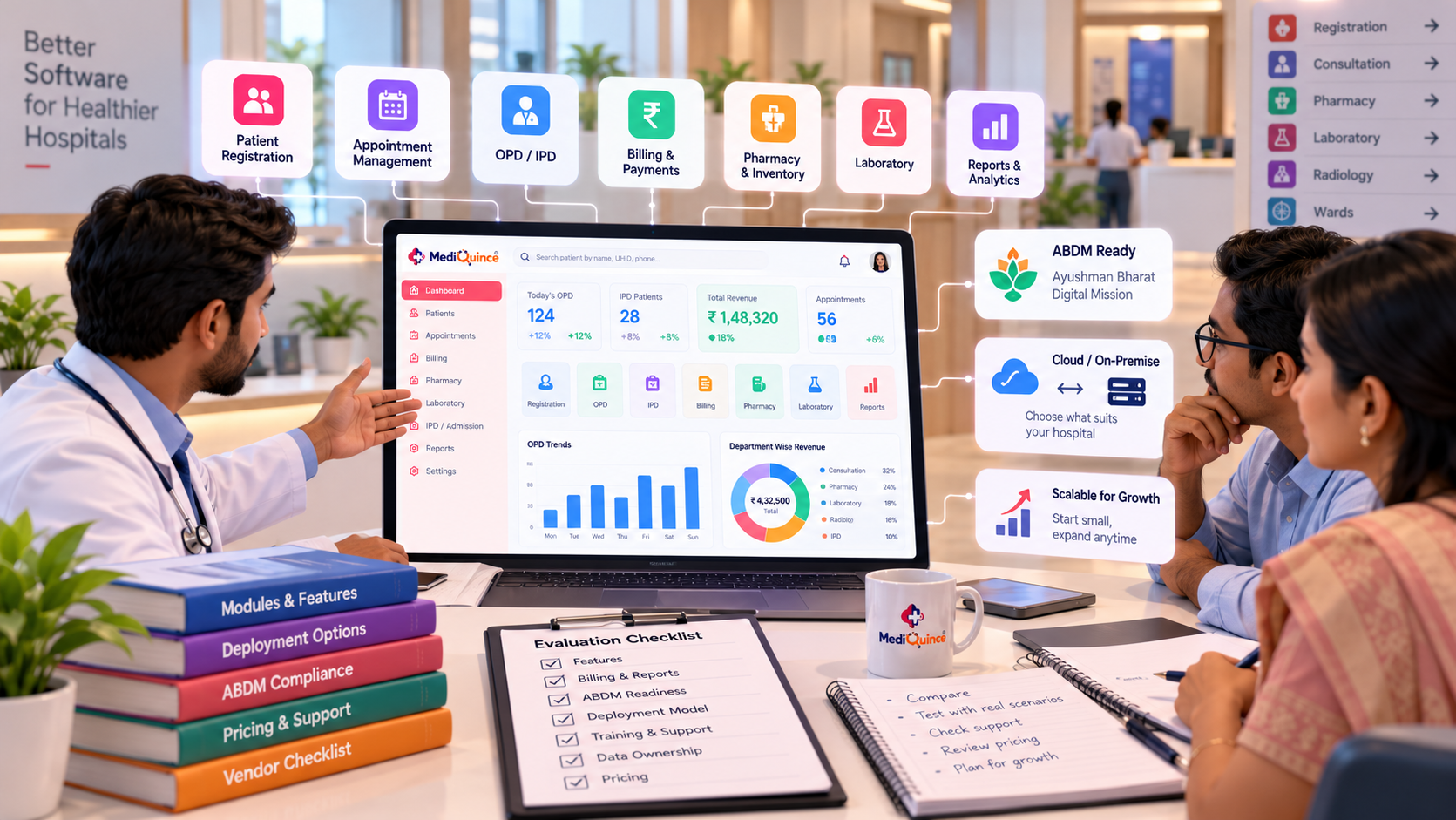
Hospital management software (HMS) puts patient registration, appointments, OPD and IPD records, billing, pharmacy, lab and reports in one system. Instead of re-entering a patient's details at each desk, staff work from one record. Owners get daily figures without waiting for someone to compile them.
Why small hospitals should shop differently
Small hospitals have constraints that enterprise vendors rarely design around:
- Limited IT capacity. There may be no one to maintain servers, so managed cloud or vendor-supported deployment matters.
- Predictable budgets. A monthly or yearly subscription is easier to plan than a large upfront licence.
- Multi-tasking staff. The software must be learnable by people who do three jobs.
- A path to grow. You should be able to add a pharmacy, lab or imaging module later without switching systems.
Modules to prioritise first
You do not need every module on day one. Start where you lose the most time or money.
Registration, OPD and IPD
This is the backbone. Look for fast registration, a way to fetch a returning patient's history, bed allocation and a clear admission-to-discharge flow.
Billing
Check that consultation fees, procedures, lab, pharmacy and IPD charges all land in one billing flow, and that you can set your own fees.
Pharmacy and inventory
If you run an in-house pharmacy, look for stock tracking, expiry alerts and purchase order support. Expired stock is a direct loss.
Laboratory
Electronic test orders and automatic report delivery save staff from printing, filing and phoning patients.
Patient records
Digital records and prescriptions mean doctors can see history at the point of care instead of searching paper files.
Reports
Ask for daily OP count, revenue and expense views you can open without help from the vendor.
Cloud, on-premise or hybrid?
Cloud software runs over the internet, so you need reliable connectivity. On-premise software runs on a local server and keeps working when the internet drops, but you carry more maintenance. Some vendors offer a hybrid: local-network use with cloud sync. Which is right depends on your internet reliability, IT support and data-control policy.
Understand the pricing model before comparing quotes
Quotes are only comparable when they cover the same modules, users, training and support. Ask whether pricing is monthly or yearly, whether it depends on beds or doctors, and what is charged for setup and customisation. Our companion guide on hospital management software cost walks through each factor.
How Mediquince fits small hospitals
Mediquince is a cloud-app based hospital management ERP that supports everything from small clinics to multi-specialty hospitals. The hospital plan is offered monthly or yearly, with bed counts and add-on doctors shaping the plan. Its software pages state a free demo, no credit card and no lock-in period. For hospitals that need to keep working offline, an on-premises option runs over a local network and syncs to the cloud, with a two-week staff training programme.
FAQs
Do small hospitals really need hospital management software?
If you handle more than a handful of patients a day across registration, billing and a pharmacy or lab, software reduces re-entry, missed charges and lost files. A very small clinic may start with appointments, records and billing only.
Which modules should a small hospital start with?
Start with registration, OPD and IPD, and billing, then add pharmacy, lab and reports as your volume grows.
Is cloud software safe for a small hospital?
Safety depends on the vendor's controls. Ask about encryption, role-based access and backups, and ask for them in writing. Mediquince's pages describe secure cloud storage and, for on-premises deployments, role-based access and activity logs.
How long does setup take?
It depends on how much data you migrate, how much you customise and how many staff need training. Ask for a timeline in writing. Mediquince's on-premises programme includes two weeks of staff training.
Quick tip : List the daily tasks that take the most staff time and start by evaluating software modules that address those tasks. Before committing, ask the vendor to demonstrate your actual workflows and confirm the full costs of setup, training, support and future modules.
Conclusion
The right software for a small hospital is the one your team will actually use every day. Prioritise the modules that remove your biggest daily frictions, insist on a demo built around your own workflow, and compare quotes on a like-for-like basis.
To see how Mediquince handles your OPD, billing, pharmacy and lab workflow, request a quote and free demo.
Mediquince Product Team
The team that designs, implements and supports Mediquince HMS for hospitals, clinics, labs and pharmacies.